How a four-person team stopped chasing nearly 120 bills and started choosing when to act
The Observatório do Código Florestal moved from manual, reactive monitoring to an operation that tracks every move in Congress, organizes the network's knowledge, feeds a public dashboard and lets it act before the window closes — without growing the team.

The routine may sound familiar.
A small team. Nearly 120 bills to track. The Chamber of Deputies and the Senate open all day long. And someone checking, one by one, what had changed.
When information arrived late, there was little time left to analyze, build a position, mobilize the network and talk to the press.
Today, the same four-person team receives every move on the bills, keeps notes and positions organized, feeds a public dashboard and gets to choose when to act.
The size of the team didn't change. What it can do did.
Four people, nearly 120 bills and a Congress to keep up with
The Observatório do Código Florestal (Forest Code Observatory) brings together 51 civil society organizations and monitors the implementation of Brazil's Native Vegetation Protection Law.
In practice, that means continuously monitoring bills that could change the rules of the Forest Code and helping the network decide when and how to act.
That entire operation rested on a team of four.
Before Sigalei, there was no shortcut.
It meant opening the Chamber's website, opening the Senate's website and checking the progress of each bill, one at a time.
“It was going into the Chamber's website, going into the Senate's website and checking one by one where things stood. Only those who've been through it know.”

That's Simone Milach, who joined the Observatory in 2018 as communications coordinator and today coordinates the network's actions.
The problem wasn't a lack of effort.
It was that there weren't enough people to follow everything that way.
When the information arrived, sometimes it was already too late
In the Observatory's work, timing matters.
A bill can be debated, challenged or amended while it is still moving through Congress. Once the decision is made, the ability to respond changes.
But the team often found out a bill was advancing only when someone outside asked about it.
Sometimes it was a journalist.
The call would come in and only then would the team realize the bill was moving fast and could be voted on the next day.
Then the scramble began.
They had to understand what had changed, consult the network, build a position and try to respond in time.
With three or four bills advancing at the same time, it wasn't always possible.
One had to be prioritized.
Another might go through before the network could respond.
And there was a less visible effect.
When one of the 51 organizations asked for the position on a given bill and the answer was “we haven't looked at it yet,” it wasn't just time that was lost.
A little of the trust that keeps a network running was lost too.
The obvious solution would be to have one person dedicated to tracking legislative progress all day.
That was exactly what a four-person team couldn't do.
The team stopped hunting for bills and started choosing when to act
The first change with Sigalei was simple: the team stopped searching for updates by hand.
The alerts started coming in.
Instead of spending part of the day visiting websites to find out whether anything had changed, the Observatory began following the bills' movements and focusing on the ones that were starting to gain traction.
That changed the order of things.
Before, a bill would advance and the team would rush to figure out what to do.
Now, positions and data could be ready ahead of time.
The team began waiting for the right moment to act.
Simone Milach points to a bill she considers especially serious. It has already passed the Chamber and is now in the Senate.
The data, the position and the campaign have been ready since June.
But they haven't been released.
The Observatory is tracking the bill and waiting for the moment it reaches the agenda.
Because publishing too early can make the issue lose momentum before its time.
The change looks small, but it completely shifts the team's position.
It no longer finds out what happened.
It prepares for what might happen.
What used to be scattered became an operation
The alerts solved part of the problem.
But over time, the Observatory realized it could use Sigalei for much more.
Bills, technical notes, positions and classifications by theme and biome are now organized inside the platform.
What used to be scattered across different files became a searchable archive.
When someone in the network asks about a bill, the team can quickly tell whether a position already exists, whether a technical note is ready, or whether that case isn't a priority right now.
Information no longer depends on someone remembering where a given document was saved.
And Sigalei stopped being just a monitoring tool.
It came to support part of the network's advocacy operation.
A simple setup became a public dashboard
That's when the team realized the information organized in Sigalei could serve far more than internal bill tracking.
The Observatory built the report it needed on the platform, with bills, links, categories and breakdowns by biome. That report is exported to a Google Drive spreadsheet, which feeds the organization's public dashboard.
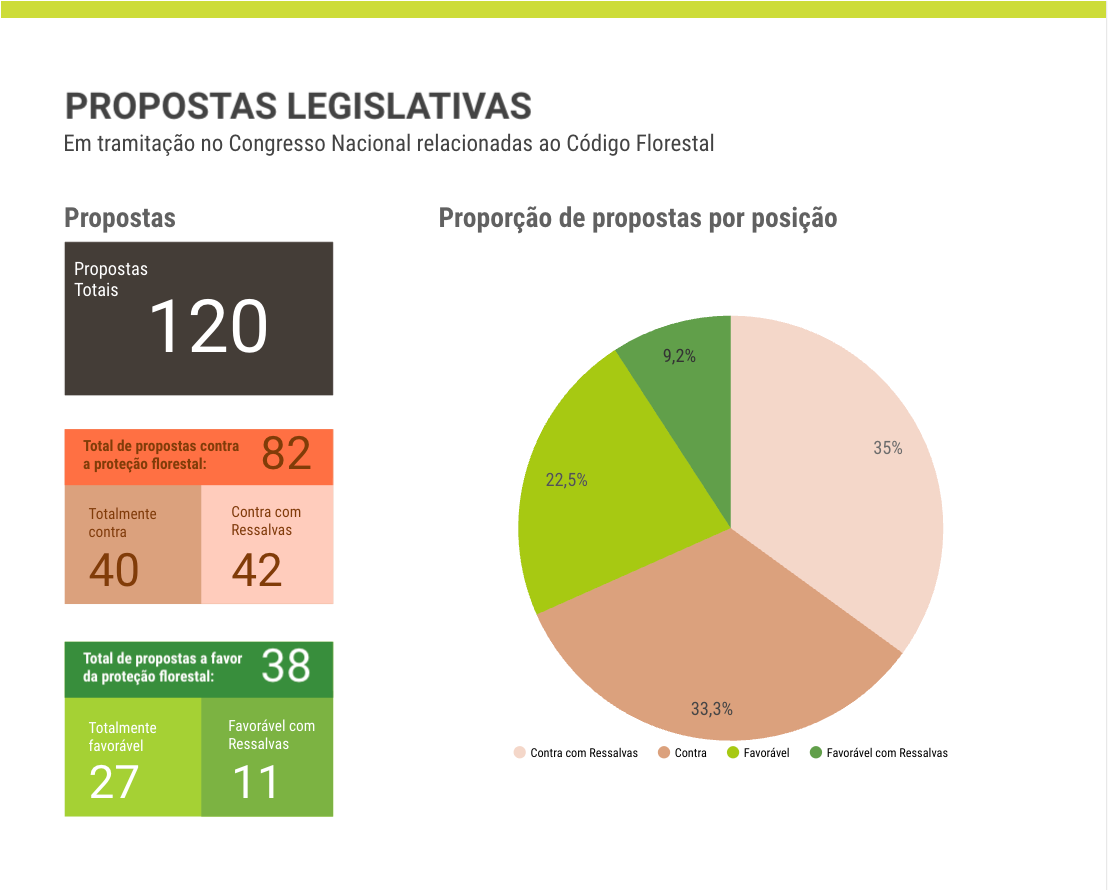
Today, anyone can look up the legislative proposals related to the Forest Code currently moving through Brazil's National Congress.
The dashboard isn't just a list of bills. The Observatory also assesses each proposal by its effect on native vegetation protection, distinguishing those considered favorable from those that weaken forest protection or threaten ecosystems.
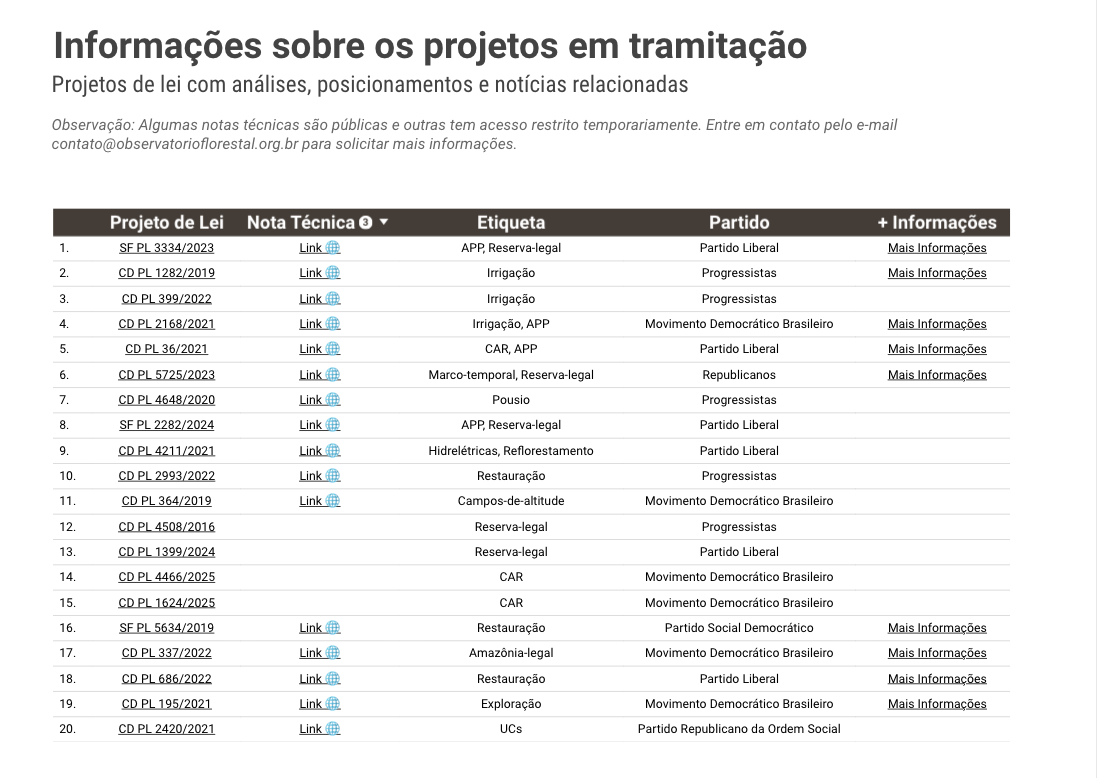
In practice, what used to start with someone opening the Chamber and Senate websites and searching bill by bill now produces a structured database that serves the Observatory's operation, the 51 organizations in the network and anyone following the issue from outside — all at once.
And that changed the relationship with the press, too.
When a journalist calls asking what's happening in Congress, Simone Milach doesn't need to start searching to build an answer.
“If a journalist calls me, I answer right away: there are 118 bills under consideration. I don't need to look anywhere — at most, my dashboard. I don't miss the chance to talk about the issue.”
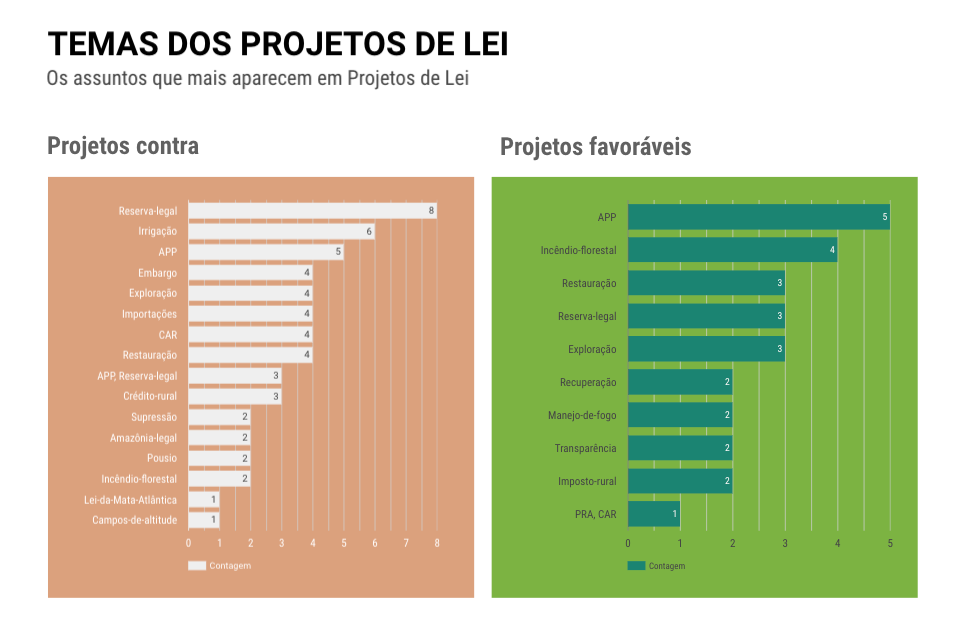
The dashboard turned information that once had to be hunted down into something already organized, up to date and ready to use when the opportunity arises.
And for a four-person team, that means more than saving time.
It means being able to take part in a conversation while it's still happening.
Four people started responding like a much larger team
The most obvious gain was time.
But the change began to show up in places that had nothing directly to do with “saving hours.”
The press began getting faster answers.
Network organizations could consult the secretariat and receive a position more quickly.
The team came to know when to act — and, just as important, when it didn't need to.
The Observatory also began tracking signs of its own impact.
Earlier this year, it spotted a congressman asking for clarification about a figure the network had published.
It was evidence that information produced by the Observatory had reached the debate inside Congress.
All of this was still being done by four people.
With information, they started competing on equal footing
The most important result may not be the automation.
It's what a small team became able to do with it.
The Observatory has already helped suspend a provisional measure and amend the text of bills to reduce impacts it considered harmful.
At the same time, it runs a public dashboard, answers the press, organizes the network's positions and tracks the movement of bills.
With four people.
For Simone Milach, that's exactly where the value of the change lies.
“In an environment short on resources, we can fight on equal terms by producing information. Civil society's strength is information. With data and arguments, we go toe to toe with any organization that has deep pockets.”
The Observatory's story isn't about replacing a person who tracked Congress by hand.
It's about what that person and the whole team became able to do once they stopped spending energy searching for information.
Before, four people were chasing nearly 120 bills.
Today, they use information to decide where to focus, when to mobilize the network, when to talk to the press and when to act.
The size of the team didn't change.
What it can do did.
Methodological note: Case study produced by Vente, a consultancy specialized in case studies for complex B2B sales. Quotes and metrics were validated with the Observatório do Código Florestal and with Sigalei before publication.
Is your team still tracking everything by hand?
If a small team still has to visit the Chamber and Senate websites every day, follow bill by bill and scramble when something gains traction, there may be a possible operation you're not seeing yet. Talk to Sigalei and find out how to structure your monitoring.
Book a demo →Related cases

“Time is our most expensive asset”
Timing, format and content: how ÉTICA Inteligência Política built, with Sigalei, a government-relations operation over seven years.

Question of Science Institute
Understand how Sigalei has been helping clients to have a more strategic performance in GovRel by capturing and organizing the most relevant information in the area of Science & Technology

Data Privacy Brasil
See how the NGO Data Privacy Brasil used the Sigalei API to develop the project "Privacy and data protection in the National Congress"