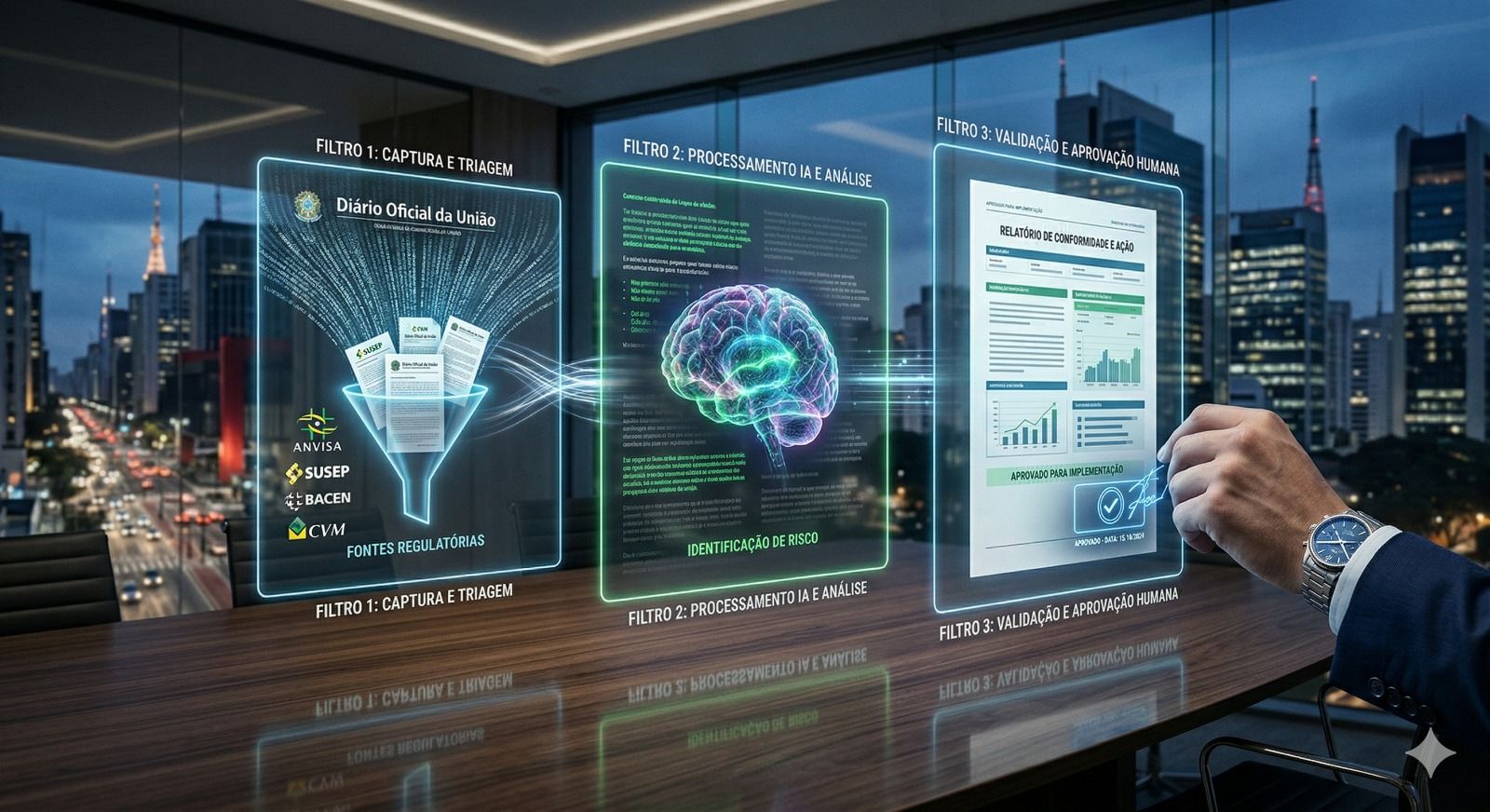

In today's corporate world, Artificial Intelligence is sold as the definitive solution to all of a company's ills. However, for C-Levels, there is an invisible danger. Trusting AI to do the strategic thinking can, quite literally, mean shooting yourself in the foot.
The truth is that the most advanced AI still has not reached true intelligence — what we call Living Intelligence, which even a bacterium possesses.
So if you are using Large Language Models (LLMs) as substitutes for your own judgment, I have bad news: you are operating with a tool that, by definition, does not understand reality.
Curious? Follow along and I'll explain it better.
The great deception of language models
The core problem is that today's AIs are, essentially, statistical engines. They don't “answer” questions; they produce sequences of text with the highest probability of occurrence, based on learned patterns. And because they have no direct experience of the physical world, they suffer from a fundamental gap: their knowledge is “secondhand,” built only from texts and descriptions.
While a baby builds a model of the world through touch and sight even before learning words, AI is trapped in symbols it does not truly understand.
So, for a leader, trusting a report generated by an AI without the human filter is like using a map drawn by someone who has never been to the territory.
The 4 layers of Living Intelligence that AI (still) does not have
To understand why human leadership is irreplaceable, we need to look at the four layers of Living Intelligence that we do not find in machines:
1. World modeling
World modeling is the ability to create an internal simulation of reality to fill in gaps in information.
AI fails at common-sense questions that a five-year-old child would solve, because its model of the world is distorted by the lack of sensory experience.
2. Active interaction
Living beings do not merely receive data; they interact with the world to seek information and test hypotheses.
AI cannot “walk around a statue” to see whether it is a cube or a pyramid; it depends only on what has already been recorded.
3. Intrinsic drives
We have an internal compass (hunger, curiosity, survival) that guides us on where we should focus our attention.
AI has no desires of its own; it follows “buttons” tuned by humans, which makes it incapable of real strategic originality.
4. Metacognition (Self-reflection)
This is the most critical layer for an executive. It is the ability to think about one's own thinking, monitor biases, and correct course.
When an AI enters “thinking mode,” it generally reviews its own error using the same wrong map that caused the initial problem.
The leader's role in the age of AI
AI can be a powerful ally, but it does not possess metacognition — that is, in practice, it does not know when it is making a mistake or “hallucinating.” It is important to stress that real progress in human history did not come from isolated geniuses or self-sufficient machines. It is the result of groups of people building on one another's work, in an effort of collective and collaborative intelligence.
The advice for C-Levels is just one: use AI as support to process large volumes of information, but never hand it the key to your strategy. After all, even a bacterium maps its environment to avoid toxins and seek food, and it does so with an intelligence that the machine, however advanced, still cannot replicate.
Delegating strategic thinking to technology represents a risk to professional autonomy; always preserve intellectual essence and human decision-making.
Don't let AI think for you. Use it to become an even more reflective and strategic leader.
Here at Sigalei, we believe that technology should serve as a new layer of collaboration, amplifying collective intelligence rather than trying to replace human critical thinking.
Want to learn more about Sigalei and what it can do for your company? Read our article Everything you need to know about Sigalei.