
The Intensification of Work with the Use of AI
The Compliance, Government Relations (GovRel), and Legal markets are undergoing a profound transformation with Artificial Intelligence. The promise is tempting: delegating routine tasks, such as summarizing information and drafting documents, to free up time for what really matters: strategy. However, recent research published by the Harvard Business Review reveals a paradox: instead of reducing the workload, AI can often intensify the work. For organizations not to get lost in this new dynamic, it is essential to understand how to use these new technologies not only to do "more," but to do "better," preserving the health of teams and the quality of decisions. With this in mind, we have prepared this special article. Happy reading!
1. The Risk of Work Intensification
Many companies focus exclusively on productivity gains but ignore the hidden cost of adopting AI. Studies indicate that the use of generative tools can lead employees to work at faster paces and take on tasks outside their original scope. In the technology sector, for example, AI has been observed to have facilitated the so-called "task expansion": professionals have begun to absorb responsibilities that would previously have been outsourced, delegated, or even avoided. By reducing technical barriers and offering immediate support, AI creates a sense of autonomy, but in practice, it silently increases the volume and complexity of individual work. This movement also generates organizational side effects, such as an increased workload for specialists, who then review, correct, and guide AI-assisted deliverables from colleagues. This reality generates three main challenges: 1.1. Fluffy Boundaries
Fluffy boundaries: the "zero friction" to start a task causes work to encroach on previously preserved intervals, such as lunch, short breaks, or even rest periods outside of working hours. Interacting with AI often seems like a light action, almost like sending a message, reducing the perception of effort. However, over time, this behavior eliminates natural breaks and transforms work into a constant presence, always subject to incremental advancement. 1.2. Excessive Multitasking
The feeling of having a "partner," in this case AI, encourages professionals to conduct multiple workflows simultaneously. It is common to alternate between human tasks and generated outputs, run processes in parallel, or resume old demands with the support of automation. Despite the apparent gain in productivity, this model intensifies the fragmentation of attention, increases the need for constant monitoring, and raises the cognitive load, creating the continuous feeling of "juggling." 1.3. Fatigue and Burnout
In the long term, this pace proves unsustainable. The intensification of work occurs not only due to the volume of tasks, but also due to the lack of adequate recovery and the implicit pressure for speed. Even without formal demands, faster patterns become the norm. With this, the quality of human judgment can be compromised, decisions tend to become more reactive, and the risk of burnout increases, especially in environments that already operate with high intellectual demands.
2. How to adopt a sustainable “AI practice”
As can be seen, what appears to be an increase in productivity in the short term can mask a silent increase in workload and growing cognitive strain, as employees deal with various AI-enabled workflows. To prevent technology from silently shaping the company negatively, leaders should adopt an “AI practice,” a set of intentional norms for the use of tools that has the following fundamental pillars: 2.1. Intentional breaks
As tasks accelerate and the boundaries between work and non-work become more blurred, brief and structured breaks act as regulating valves for the pace. These intervals, such as "decision pauses" or moments of critical reflection, require professionals to review hypotheses, evaluate the impact of choices, and explicitly align them with organizational objectives before moving forward. These pauses prevent the silent accumulation of cognitive overload and deviation errors, favoring more thoughtful decisions and preventing burnout in AI-influenced environments. 2.2. Work Sequencing
Since AI allows for background tasks and virtually continuous notifications, sequencing seeks to determine not only what and how work progresses, but when it should progress. This includes practices such as grouping alerts, withholding non-urgent updates, and protecting focus windows where people are shielded from interruptions.
2.3. Human Basis in Working with AI
As AI facilitates more individual and autonomous tasks, protecting time and space for human interaction becomes an essential counterweight. Small moments of connection, such as quick check-ins, shared reflection sessions, or structured dialogues, break the continuous engagement with AI tools and restore critical perspective, empathy, and a sense of organizational context. And, as one of our clients has already reported, the use of AI frees up time precisely so that the team can focus on the “institutional and political relationship process.”
3. Intelligence for control, not for overload
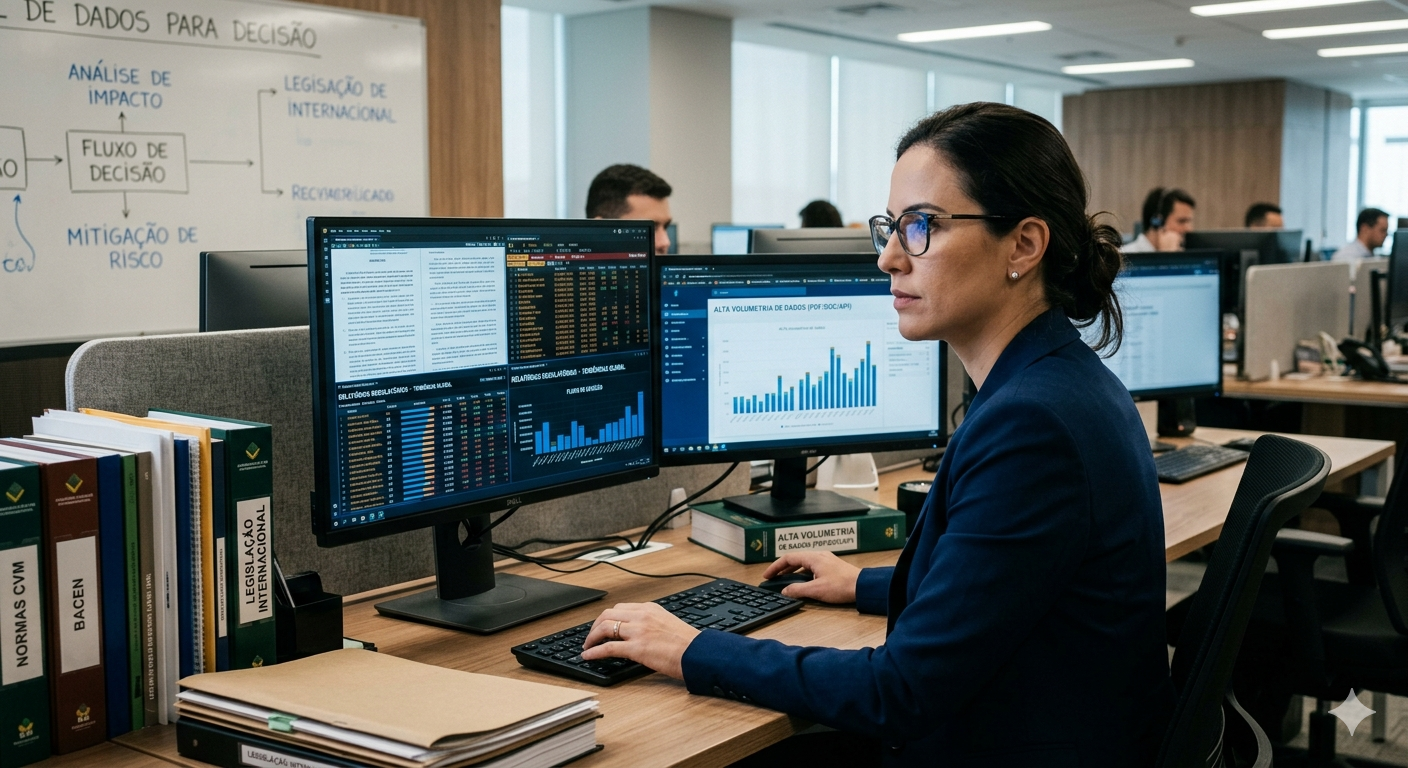
In companies with regulatory complexity, what is expected of an AI platform is that it offers “strategic control,” collecting, organizing, and analyzing documents, transforming them into actionable intelligence. Instead of simply accelerating the pace, which could lead to an intensification of work and burnout among teams, the platform should focus on organizing and automating processes so that agility does not result in overload. It should possess the following functionalities to ensure that agility does not turn into chaotic haste. 3.1. Automatic curation and precision
Unlike generic tools that can increase informational “noise” and cognitive load, the platform should focus on automatic curation. This functionality, a true “game changer,” ensures that the right information reaches the right people at the right time, preventing the team from wasting time on secondary tasks and allowing them to focus on institutional and political relationships. Precision combats the AI's tendency to unnecessarily expand tasks, maintaining focus on what is relevant to the organization's strategy. 3.2. Real-time monitoring
Monitoring should encompass official gazettes and legislative proposals at the federal, state, and municipal levels. The platform should automatically identify new proposals, regulatory changes, and committee agendas, sending personalized alerts. This automation eliminates the "anxiety of manual searching" and the need for constant monitoring, ensuring that stakeholder and competitor movements are tracked without gaps. 3.3. Workflow and Automation
Another key point is enabling the creation, management, and measurement of action plans (CRM) and tasks with precision. While the haphazard use of AI can create "blurred boundaries" between work and rest, strategic workflows structure the workflow into coherent phases. The system automates the sending of deadline reminders and the collection of evidence of regulatory compliance, ensuring that team productivity is monitored in a balanced way and that corporate memory is preserved in a centralized repository. 3.4. Dashboards (BI)
Dashboards should allow for the quantification of the qualitative, translating complex compliance and risk data into clear metrics. This solves one of the biggest pain points in Compliance and Governance areas: the difficulty of demonstrating value to management. By instantly generating reports and metrics from a centralized database, the platform eliminates the exhausting effort of manual reporting, protecting the team against cognitive fatigue and allowing for more informed decision-making.
Conclusion
Artificial Intelligence is redefining the value of professional services. Success will not come from those who work the most hours, but from those who know how to carefully integrate technology into the daily rhythm. And, when it comes to integrating technology into the daily lives of companies, Sigalei positions itself as that strategic ally, allowing analysts and managers to move from "reactive" to "proactive" mode. As a client testimonial summarizes: "when we need it, the information is just a click away". Here you'll find automatic curation and precision, real-time monitoring, workflow and automation, dashboards that make sense for your business, and everything else you're looking for in an AI platform. This doesn't just mean faster speeds; it means the peace of mind of knowing that monitoring is guaranteed, allowing human talent to dedicate themselves to what machines cannot replace: strategy and human connection. Is your organization ready to take control? Transform documents into actions and intelligence with Sigalei. Request a demo.